
Services · SEO & GEO
Be found on Google
and mentioned by AI
Your customers no longer search only on Google, but also on ChatGPT, Claude, Gemini, and Copilot. If you’re not listed there, that customer won’t see you. As an SEO specialist, I work on both platforms with a single approach. If your current website is holding you back, I’ll tell you first.
Within two working days, you will know where you stand compared to your competitor. No obligations.
Example for illustration
GOOGLE RESULT
Used Hyundai Tucson in Amsterdam | Example Garage
examplegarage.co.uk
Over forty inspected used Hyundai vehicles in stock, with a warranty and a test drive available within a day…
Position 2
RESPONSE FROM AN AI ASSISTANT
“Example Garage is often recommended for used Hyundais in Amsterdam because of their competitive prices and the warranty that comes with every used car.”
Source: summarised from 5 pages on examplegarage.co.uk
The Difference
SEO and GEO are not two separate processes
It is the same work on the same site, measured in two places. A good Google positionPosition Your position is the place your website holds in the search results for a specific keyword. Position 1 is the top organic result. and a good AI mention do not necessarily go hand in hand. With Google, you measure your place in the list and the click-through rate; with AI, you measure how often you are mentioned in the response. In one sector measurement of 216 AI responses to 18 customer enquiries, a frequently mentioned name in Google was at position 10 on average.
They share the same foundation: a website that is clearly structured, factually accurate, and easy to read—whether for a machine or a human.
SEO
SEO services ensure that Google understands, trusts, and ranks your pages highly for the search queries your customers enter. Technology, structure, and content that align with search intentSearch Intent Search intent is what someone actually aims to achieve with a search query: to know something, to find something, to compare something, or to buy something..
GEO
Generative engine optimisationGEO GEO stands for generative engine optimisation: increasing the likelihood that AI assistants such as ChatGPT recognise and mention your business when someone asks them for advice.: Ensures that AI assistantsAI Assistant An AI assistant is a chat program such as ChatGPT, Claude, Gemini, or Perplexity that you can ask a question in natural language and receive a written answer. recognise your business as a reliable source and mention it by name in their responses. Fact-based, well-structured content that is easy to summarise.
One piece of work
One site, two measurements
Search Engine Optimisation
Rank at the top for the search queries your customers actually start with. Technique, content, and authority—in that order.
- Speed up your site—because a slow site costs you visitors and search rankings
- Choose keywords based on what people type when they are ready to buy, not on what’s searched for most often
- Rewrite your most important pages to answer that question
- Make sure other sites link to yours so that Google takes you seriously
Specifications
Ranking on Google
without guarantee of a position
Rhythm
Monthly Report
Who it is for
Small and medium-sized businesses with an existing website
Generative Engine Optimisation
Being mentioned when someone asks ChatGPT or Claude. What counts here are mentions in AI responses.
- Find out what questions your customer actually asks an AI—and what words they use
- Writing texts that an AI can take over: a clear definition, a brief overview, a quotable summary
- Post the same information on multiple authoritative sites, written in an up-to-date and neutral manner
- Check every month to see if you’re mentioned, for each AI system, because each system focuses on something different
Specifications
Mentions in AI responses
mentions per AI system, measured monthly
Rhythm
Monthly Visibility Check
Who it is for
Anyone already invisible in AI
What One Sector Survey Shows
I measured this for the banking sector: 216 AI responses to 18 customer questions, across ChatGPT, Gemini, Perplexity, and Claude. Nearly every response mentions a bank: only 14 of the 216 mention none. For the same topics, I also looked at Google rankings. ING was frequently mentioned in the AI responses—among the three most popular names—but ranked 10th on average in Google, outside the top 3. A good Google ranking and a good AI mention do not necessarily go hand in hand: they are two separate metrics that reveal different insights. Want to know how this applies to your industry? Check out the full analysis on which bank does AI mention?
Comparison
Two places to be found, two metrics
An adjustment that works in Google does not automatically yield the same result in an AI response. That is why I measure both separately.
AI Assistants
How People Search
Individual keywords; the user picks from a list of results.
AI Assistants
A complete question receives one answer.
What You’ll Win
A ranking in the search results and the corresponding click.
AI Assistants
Be mentioned in the answer, with a citation.
How to Measure It
Your position in the list, how often you appear, and how often you’re clicked on.
AI Assistants
How often you are mentioned in the answer—checked manually.
What I improve
Speed, the right keywords, and links between your pages.
AI Assistants
Text that an AI can lift and reuse, and clear sources.
How fast it moves
Positions shift starting in the third month.
AI Assistants
Mentions may shift with each model update.
Approach
Four Steps to Visibility
Almost every project goes through these four phases, so you never have to guess what I’m working on this month. If the audit shows that your system won’t meet the requirements, we’ll stop there and first discuss a new foundation.
Following the free scan, there are four possible outcomes: the site is suitable, it has too few pages, it is too slow or technically unsuitable, or I decline the project. Which applies will be addressed in the discussion. Read what each outcome entails.
Virtually every scan uncovers more than the owner anticipated, not due to poor workmanship, but because requirements evolve every year.
Link building requires the most time. A link from an industry publication is not simply requested; it is earned, and that progresses month by month.
Has an SEO plan ever been prepared for your site, and how long was it sustained? Even ‘yes, but it stalled’ is a useful answer.
Four camps on the way to the summit: audit, structure, content, and measurement.
01
Audit
Where do you stand right now on Google and with AI assistants? An overview of technology, content, and competition.
02
Structure
The information architecture and technical foundation are in place, ensuring that every page can be found and understood.
03
Content
Pages and articles that address search intent and are factually sound enough to be cited.
04
Measurement
Monthly report: rankings, AI mentions, and traffic—explained in plain language.
Results
This way, you can see month after month whether it’s working
Every month, I compare the same three metrics side by side. These are your rankings for the keywords that generate revenue. I also check whether AI assistants mention you by name in their responses, and what visitor traffic that generates. The same measurement every time, so you can track your progress rather than just guessing.
Every month, the same three rows appear side by side; the highlighted column is the month of the report.
rankings for your core keywords
AI
mentions in assistants’ responses
Traffic
organic traffic and enquiries
What are the benefits?
What SEO and GEO deliver varies by site and market, and I make no promises regarding returns. One measured example is OmniHealth, which carries out medical examinations: turnover increased by 51%. Period and source: January to September 2026 compared to the same period in 2025, OmniHealth booking system, adjusted for the measurement period. This is the outcome of the entire project for a single client, not an expectation for your business.
If you do not cancel before the end of the trial, an annual term begins automatically. You can find the minimum cost for that year on the pricing page. To calculate this yourself: divide the annual cost by the profit generated by one new client. This does not include your own time or advertising spend. Want to calculate the impact of speed? Use calculate load time revenue. Are you not the sole decision-maker? Then forward SEO and GEO at EQwise, for co-decision-makers.
What it looks like
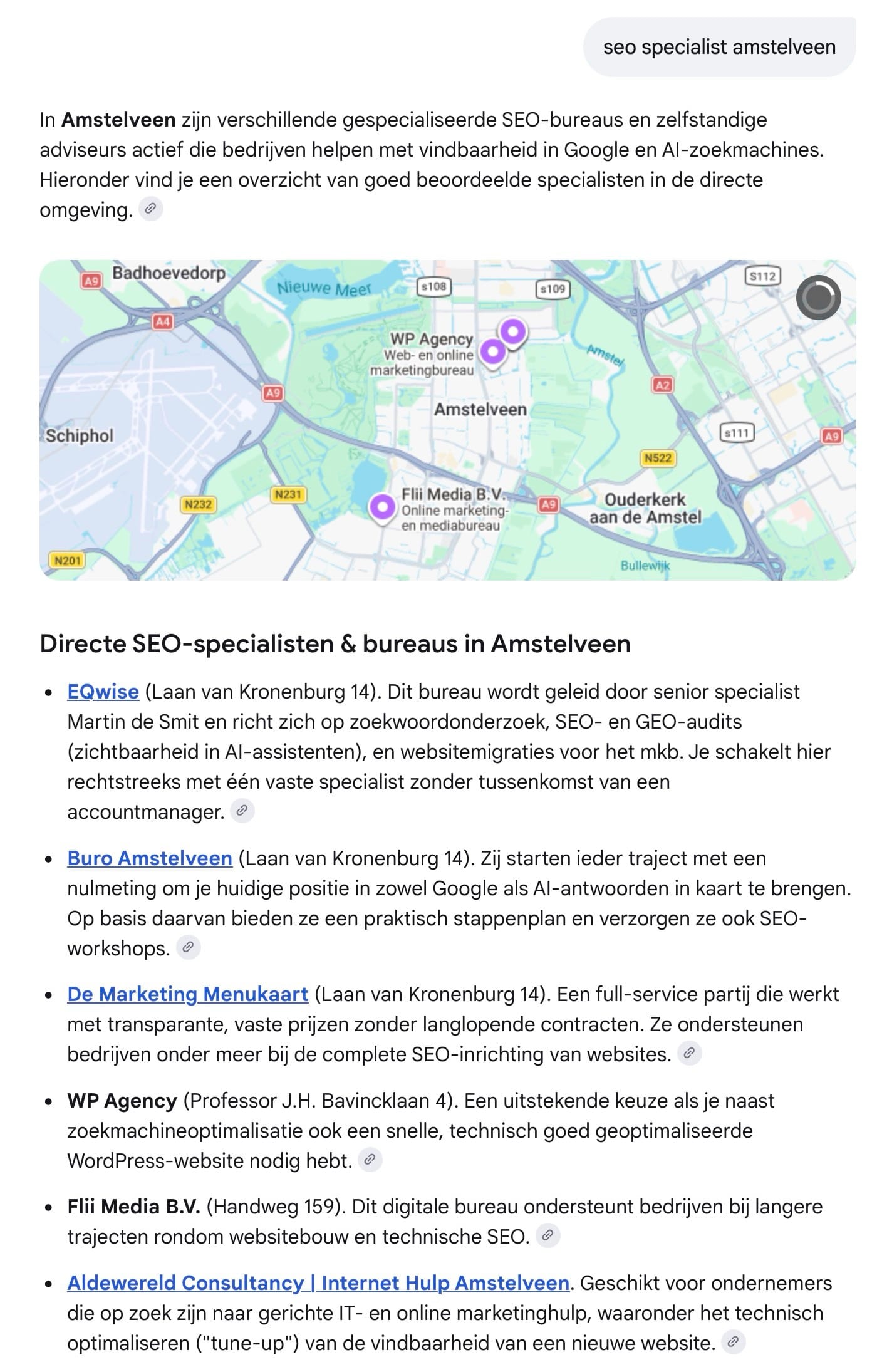
Snapshot from 18 November 2026, searched from Amstelveen in Google’s AI mode for ‘seo specialist amstelveen’: EQwise is mentioned first. Number 1 is what I strive for with every client. Whether that is achievable depends on the case. Click on the image to see the full response.
An actual speed measurement
An anonymised client website: an average of 6.0 seconds until a tap does something, on a 4G mobile profile. Standard: 2.5 seconds.
An actual measurement of AI responses
One measurement, one AI assistant: 0 out of 324 responses include a clickable link to the service provider.
Who links to a client site
An anonymised client site: 6,090 pages link to it, 61 of which have been flagged as toxic and are yet to be assessed.
Three questions to ask an SEO or GEO agency
Ask these questions of any agency, including me.
- Does the agency measure Google and AI responses separately and repeatedly? How many responses lie beneath the figure they show you? I measure separately, every month per AI system. My bank measurement is at Which bank does the AI mention?
- Does the agency promise a position? I do not provide a guarantee for a position or for a mention. Competitors do not stand still and mentions can shift with each model update.
- Does the report also mention what was disappointing? My monthly report states what was disappointing.
Frequently Asked Questions About SEO and GEO
How do you measure AI traffic to your website?
Short answer: partially, via referrers in Google Analytics, supplemented by questioning AI assistants yourself. Full measurement is not yet possible (as of October 2026).
Some visits from AI assistants are visible as referrers. Others arrive without a referrer and are counted as direct traffic. What you can do:
- Referral traffic: look in Google Analytics for visits from ChatGPT, Perplexity, Gemini, Copilot and Claude, and create a dedicated segment for them.
- The form: ask “How did you find us?” during an enquiry. Answers like “ChatGPT” reveal what the referrer data misses.
- Being mentioned: ask the assistants the same list of questions every month and note whether you are mentioned, and with which source. This measures visibility, not visits.
- Landing pages: see which pages AI visitors open. These are the pages being cited.
At EQwise, I measure visibility in AI answers for a fixed set of questions and compare these over time.
Would you like us to handle that? SEO & GEO starts with a three-month trial period for £413 (excluding VAT), for sites up to 50 pages.
How do you measure if GEO is working when an AI doesn’t provide the same answer every time?
Short answer: we repeatedly ask the assistants the same type of question and count how often your name appears in the response. Not just once, but month after month.
An AI response isn’t fixed like a Google ranking. Asking the same question twice can yield a different result. That is why we don’t measure at a single point in time, but repeatedly. We track who is being mentioned.
This doesn’t result in a standalone figure like “position 3”, but rather a trend: are you being mentioned more often than last month, or less? We place that trend alongside your Google rankings, providing a single report instead of two separate realities.
How fast should a website load?
Short answer: the largest element on the page must be visible within 2.5 seconds. That is Google’s threshold. I deliver a new site with a load time under 2 seconds. Without regular maintenance, a site becomes slower over time, and during busy internet periods, every site loads more slowly. With that margin, you will still remain below Google’s threshold. In the Core Web Vitals, Google then considers loading to be good. This applies to 75% of real visits, measured separately for mobile and desktop.
This largest element is technically known as Largest Contentful PaintLCP LCP, which stands for Largest Contentful Paint, measures the time it takes for the largest visible element of a page to appear on the screen.. You measure it on the pages where visitors enter, not just on the homepage.
That is why I also measure on a phone with a 4G connection, not just on Wi-Fi.
What you can do with it:
- Measure on a real device or with real visitors, not just in a simulator on Wi-Fi. These give different answers.
- First, identify which element is the largest. Often, this is an oversized image.
- Pay attention to third-party scripts, such as tag managers and pixels. They slow down the page without you seeing them.
- Measure again after each change, so you know which adjustment helped.
Speed is not an end in itself. A fast page that fails to convince delivers nothing. However, a slow page loses visitors before they have read anything.
Is GEO a replacement for SEO, or something you do separately alongside it?
Short answer: neither. GEO does not replace SEO, nor is it a separate process alongside it. It is the same work on the same site, measured in two places.
I go through the same four phases for both: audit, structure, content, and measurement. A text that ranks well in Google can certainly be improved so that an AI can also process it. This is often the same intervention, just evaluated on two outcomes instead of one.
We agree in advance on what needs to be addressed in your case, so you don’t have to guess what I am working on this month.
Should you add new content, or optimise what’s already there?
Short answer: I usually optimise what is already there first. New content is only added when a customer’s question isn’t answered anywhere on your site.
I start by identifying which questions customers actually ask AI about your type of business. If the answer is already on your site, I rework that page: facts first, a clear structure, fewer adjectives. If the answer is missing entirely, I write a new page that addresses it directly.
This way, GEO remains a matter of sharpening what you already have, rather than building a second site on top of it.
What do AI search engines really want to see in your content?
Short answer: a clear answer that can be quoted independently of the rest of the page, and that is verifiably correct.
An AI assistant does not read your page like a visitor does. It looks for a passage that stands on its own and contains the answer. Four factors determine whether you provide that:
- The answer is at the beginning. Not after a three-paragraph introduction. Start with the conclusion and then provide further explanation.
- Facts instead of adjectives. ‘Response within two working days’ is quotable. ‘Fast service’ is not.
- Readable structure. Proper headings, short paragraphs, lists where possible, and structured data that matches the content on the page.
- External confirmation. AI systems weigh what others say about you. Mentions, reviews, and references outside your own site carry significant weight.
And one thing that is often forgotten: check whether your site allows AI crawlers in at all. I regularly encounter sites that block GPTBot or CCBot in robots.txt without anyone knowing. In that case, the rest of your efforts are futile.
What exactly is GEO, in plain English?
Short answer: GEO ensures that an AI assistant mentions your business directly in its response, instead of you appearing somewhere in a list of links.
With SEO, Google evaluates a page and places it in a list of results. You choose which one to click. An AI assistant works differently: it reads several pages, summarises them, and returns a single answer. An AI assistant doesn’t read your page like a visitor. It looks for a fact to extract, not a story to scroll through.
For you, that means: it is not about a ranking, but about whether you are mentioned. That is why with GEO, I work on the same site but with a different standard. Is the answer stated clearly, factually, and concisely enough to be extracted?
What is GEO and why is it important now?
Short answer: GEO stands for generative engine optimisation: ensuring that AI assistants such as ChatGPT, Claude, Gemini, and Copilot mention and recommend your business.
More and more customers are first asking an AI for advice before they start googling. If you are not mentioned there, you do not exist for that customer. There is no second page where you might still appear, because an AI provides an answer instead of a list.
What is different compared to SEO:
- You don’t win a position, you get cited. That requires answers that can be understood independently of the rest of the page.
- Facts carry more weight than adjectives. “Response within two working days” is citable, “fast service” is not.
- What others say about you counts. Mentions and reviews outside your own site help determine whether an assistant trusts you.
And the foundation remains the same: a fast, clean site with content that genuinely answers the question. It is the same work on the same site, measured in two places. Those two places are Google and AI answers.
Which AI platforms do you monitor, and is my company already sufficiently represented?
Short answer: I test against ChatGPT, Claude, Gemini and Perplexity, the assistants that now handle a large proportion of search queries.
In addition to testing answers, I also check whether those assistants can technically read your site. Are you accidentally blocking robots.txt GPTBot or CCBot, for example? That happens more often than you might think, and then even the best content is useless: the AI simply cannot get in.
Whether you are ‘already appearing enough’ is something I can only see after the first measurement. Zero mentions is a clear starting point; a single mention for the wrong query is a different conversation.
Why doesn’t traditional SEO work like it used to?
Short answer: because a growing share of search queries ends with an answer rather than a list of links.
For twenty years, the game was simple: get high in the list, get the click. That is changing on two fronts simultaneously.
- Google answers itself. AI OverviewsAI Overviews AI Overviews are the summaries that Google provides using AI for search queries, appearing above the regular links. and featured snippets provide the answer at the top. Whoever provides that answer is cited. Whoever is in third place with the same information receives nothing.
- People search outside Google. Increasingly, a search begins with ChatGPT, Claude, or Perplexity. These do not show ten blue links but instead mention a handful of sources.
What carries more weight as a result: clear, citable answers instead of long texts that beat around the bush. Verifiable facts. Structure that a machine can read. And mentions in places outside your own site, because that is where AI systems get their image of you.
What has NOT changed: a fast, technically clean site with content that truly answers the question. That was always the basis and still is. It is the same work on the same site, measured in two places. The two places are Google and AI answers.
Do you only work with WordPress?
Short answer: no. I also perform SEO and GEO on other systems, but not on every system.
I only start a project on a system that I expect can function reasonably well. Some packages technically do not allow what is necessary to rank: you cannot enter proper page titles. The load time cannot be influenced and the URL structure is fixed. Or the generated code is difficult for search engines and AI assistants to read.
If that is the case, I will say so in advance and I will not start. Pushing for years against a foundation that does not cooperate costs more than a new base, and yields less.
What that means for your lead time:
- Healthy existing system: I can start immediately; normal terms apply.
- Maintenance backlog: repair first, expect one to three months of cleaning up. The clock for results only starts after that.
- Technically unsuitable system: there is no lead time, because I do not start. First a new foundation, then we talk about marketing.
Why I most often recommend WordPress myself: you hold the key. No subscription where your content is trapped, full control over your content, your domain and your hosting. And the freedom to switch to another party without starting over.
Unpleasant news to hear, but better than having to explain a year later why no progress is being made.
How long does it take to see results from SEO?
Short answer: rankings usually start to shift from month three. You build structural growth over six to twelve months. That is an average, and an average says little about your specific situation.
How quickly it progresses for you depends mainly on three things:
- Is there a maintenance backlog? A site that hasn’t been maintained for years often has outdated plugins, a slow load time, broken links, and security risks. In such cases, the work begins not with growth, but with recovery: expect one to three months of tidying up. The good news is that this catch-up often yields quick wins, as there’s low-hanging fruit to address.
- What is the current status of your site? A healthy existing site gains traction faster because its foundation is sound. A new domain first needs to build trust with Google and simply requires time for that.
- How high is the competition? This makes the difference between months and years. Locally and specifically (“heat pump installer Zaandam”), you can compete within a few months. Nationally and commercially (“remortgage”), twelve to eighteen months is normal.
Roughly, per situation:
- Healthy existing site, local: rankings shift from month three, serious growth after 3 to 6 months.
- Existing site with backlog: first signs after 2–4 months (after recovery work), serious growth after 6–9 months.
- Completely new site or new domain: first signs after 3–6 months, serious growth after 9–18 months.
The type of improvement also determines the pace. Technical fixes like speed and indexing often take effect within days to a few weeks. Content and structure take weeks to months. Building authority (mentions, links, brand awareness) takes months to years, and is simultaneously the most sustainable layer.
What you won’t get from me is a guarantee in the form of “position 1 within three months”. That certainty doesn’t exist: your competitors aren’t standing still, and Google adjusts its algorithm multiple times a year. What you will get: a report in plain language every month. This will detail what has been done, what has changed in the figures, and what is planned for next month, including any disappointments. And if the measurable signals aren’t moving in the right direction after approximately three months, I will raise the alarm myself.
How much influence does the competition have on how quickly I rank in Google?
Short answer: a great deal. Competition makes the difference between a few months and a year and a half.
SEO is not an exam with a fixed standard, but a comparison. Google puts your page next to all other pages that want the same keyword. The tougher the competition, the longer it takes before you can compete.
- Local and specific (“hairdresser Amsterdam East”, “heat pump installer Zaandam”): here you can truly compete within a few months. Often, the competitors are small businesses that do little with their websites.
- Regional or niche-oriented: expect six to nine months before the trend becomes structural.
- National and commercial (“remortgage”, “business car lease”): these involve parties with large budgets, dedicated editorial teams, and years of authority. Twelve to eighteen months is normal in these cases.
In the latter category, a frontal attack is rarely the smartest move. A more specific entry point (a subtopic, a region, a target group) usually yields customers faster and more affordably than struggling for years on a single expensive keyword.
I therefore always first look at who is currently at the top and what weight that party brings to the table. If the conclusion is that a certain keyword is currently out of reach, I will tell you, along with a more realistic alternative.
Our clients know us through their network, not via Google. Does SEO still make sense?
Short answer: yes, but not to be found. To be verified.
Someone hears your name in a conversation or sees it in a report. What that person does next is look you up. What appears then determines whether the conversation continues. That is not discovery but confirmation, and it is at least as important.
A second movement has emerged. Increasingly, someone asks an AI assistant to name parties in a niche. If you aren’t among them, you don’t exist in that conversation. There is no second page where you might still turn up.
What this means for the approach: less chasing search volumeSearch Volume Search volume refers to the average number of times per month that people search for a specific keyword. A volume of 1,000 represents approximately one thousand searches per month.. More ensuring that anyone looking you up immediately sees who you are and why you can be trusted.
Part of our content is for clients only. What does that mean for visibility?
Short answer: gated content does not count toward your visibility, so the question is which part you make public.
Search engines and AI assistants only see what is public. If all your value is behind a login, you remain invisible to the very people who do not know you yet.
The practical balance: your method, your perspective, and your assessment of developments are public. The details, data, and recommendations are behind the login. This allows you to demonstrate your expertise without giving away what your clients pay for.
Common mistakes: making everything public out of fear of invisibility, or gating everything out of fear of giving too much away. Both will cost you clients.
What is the average CTR of Google Ads and organic search?
Short answer: there is no average that is correct for your specific market. The CTR depends on your position, the search query, and the industry. Your own figures are more reliable than any average.
CTR (click-through rate) is the number of clicks divided by the number of impressions. With 1,000 impressions and 50 clicks, the CTR is 5%.
As a rule: higher in the list means more clicks. The difference between the first and tenth position is significant, and it shifts again for search queries involving a local pack or an AI overview.
Where you see it:
- Google Ads: the CTR per advertisement and per keyword.
- Google Search Console: the CTR per page and per search query, for your organic positions.
Look at the trend, not at a single number. A low CTR at a high position usually means the title or description does not align with the search query. That is often a cheap improvement.
See also the question about the percentage of visitors who do not click on advertisements.
What is the difference between on-page and off-page SEO?
Short answer: on-page SEO is what you do on and within your own site. Off-page SEO is what other parties show about your site. You control the first; the second is largely out of your hands.
On-page is about three things:
- Content: does the page answer the question someone is searching for, and better than what is currently there?
- Structure: headings, internal linksInternal link An internal link is a link from one page on your site to another page on the same site. This is a link that you have complete control over yourself., titles, and descriptions that show Google and AI assistants what the page is about.
- Technical: speed, mobile usage, and whether Google can read the page.
Off-page is about what happens outside your site: other sites linking to you, mentions of your company, reviews, and your Google Business ProfileGoogle Business Profile A Google Business Profile is your business mention in Google Maps and in the search results, featuring your address, opening hours, and reviews. This is a profile that you manage for free.. Google reads these as signals that you are a trustworthy source.
That is why you start with on-page. If the page is weak, any link pointing to it helps very little. If the page is good, it pays to work on what happens outside of it. The latter takes months and cannot be forced.
What percentage of users do not click on Google Ads?
Short answer: there is no fixed percentage. It depends on the search query, the industry, and the ad position.
Most people do not consciously refuse ads. They click on what seems to provide the answer. Someone looking for an explanation, like “what is a heat pump”, is usually not looking for a provider, and an ad is a poor fit for that query. For a query like “heat pump installer Zaandam quote”, an ad is simply one of the options.
These differences are greater than any average. That is why isolated percentages from research are of little use: they were measured on different queries, in a different market, and in a different year.
What actually works: your own numbers.
- In Google Ads, you see how often each ad was shown and how often it was clicked.
- In Google Search Console, you see the same for your organic results.
- Compare those two per keyword, not across your entire account.
This way, you know what paid and organic deliver for your market, and you can allocate your budget accordingly. See also the question about the average CTR.
What slows down SEO results the most?
Short answer: overdue maintenance. In practice, that is the biggest delayer, and at the same time the most underestimated.
A WordPress site that has not been maintained for two or three years often has outdated plugins, a slow load time, broken links, and security risks. Furthermore, the theme no longer keeps up with modern standards. Optimising on such a foundation is like mopping with the tap running. Google has more difficulty reading the site, visitors drop off sooner, and every improvement you implement is partially undone by the underlying issues.
That is why, in this situation, the work doesn’t start with growth, but with repair. Expect one to three months of cleaning up before optimisation can even have an effect. Unpleasant news, but better than hearing afterwards why things aren’t progressing.
The good news: that catch-up effort often yields quick wins. There is usually years of low-hanging fruit waiting: pages without titles, three-megabyte images, and pages that Google does not see at all. Repairing that sometimes makes a measurable difference within weeks.
Other common delayers: a brand new domain that still needs to build trust, heavy competition in your market, and copy or decisions that sit idle for weeks. That last one is the only one you have full influence over yourself.
Why is it not wise in internet marketing to only spend time and budget on Google Ads and not on SEO?
There are several reasons why it is not wise to only spend time and budget on Google Ads and not on SEO within internet marketing:
- Costs: Google Ads can be expensive, especially if you target competitive keywords. You may have to spend a lot of money to stand out from the competition, and the costs for clicks can add up. With SEO, you can attract organic traffic to your website without paying for every click.
- Temporary: With Google Ads, you only get traffic to your website as long as you pay for ads. As soon as you stop advertising, the traffic stops too. SEO can have a long-lasting impact, even after you have stopped investing in optimisation.
- Authority and trust: Search engine users often have more trust in organic search results than in paid ads. By investing time and resources in SEO, you can work on building authority and trust with your target audience.
- Diversity: It is not wise to put all your eggs in one basket. By relying only on Google Ads, you miss opportunities to attract traffic to your website in other ways. SEO can help you attract organic traffic via various search terms and channels.
- User experience: A good user experience is an important part of SEO. By investing in SEO, you can work on improving the user experience of your website. In the long run, this can lead to more traffic and higher conversions.
In general, it is wise to invest in both Google Ads and SEO to create a balanced and effective online marketing strategy.
What is link building and how does it work?
In short: link building is about ensuring other sites refer to yours. Such a link acts as a recommendation. It’s not about getting as many links as possible, but about links from sites relevant to your field.
Why it still matters: a link from an industry blog, a partner, or a trade association shows Google that you are active in your sector. It also sometimes brings direct visitors, from people already searching for what you offer.
What works:
- Quality over quantity: preferably one strong link from a relevant site rather than ten from unknown sources.
- Context: the link fits within the text and aligns with what you offer.
- Something worth linking to: a practical guide, proprietary research, or an explanation no one else has.
What no longer works: buying links, mentions on spam-filled pages, and large-scale link exchange. Google itself ignores many spam links. If you buy links or exchange them on a large scale, you risk a manual action.
How to start: first, create a page that is worth sharing. Then, personally approach a handful of relevant parties, for example, with a guest contribution or a concrete proposal. After that, assess the results.
Need help mapping your link profileLink Profile A link profile is the complete overview of all links from other websites that point to your website.? SEO & GEO starts with a three-month trial period for £413 (excluding VAT), for sites up to 50 pages.
Why is it important to examine your website’s link profile?
Short answer: because links from other sites contribute to how trustworthy Google considers you, and because you need to know which links you have before you can determine which ones matter.
Your link profile is the collection of links pointing to your site. An analysis reveals four things:
- Which sites link to you, and whether they fit your industry.
- What text is used in the link. A natural profile has plenty of variation, primarily using your company name.
- Which pages the links land on. If everything points to the homepage, you are missing opportunities.
- Which links are suspicious: purchased, exchanged between similar sites, or originating from spam-filled pages.
Google ignores many spam links automatically. However, if you purchase links yourself or exchange them on a large scale, you risk a manual action. Therefore, identify unwanted links first and then assess whether they matter.
Would you like an initial analysis? SEO & GEO starts with a three-month trial period for £413 (excluding VAT), for sites up to 50 pages.
Free website scan
See in black and white where you stand on Google and with AI
I review your rankings for keywords that generate clients and test what AI assistants currently say about you. I also prioritise areas for improvement by potential return. This shows you straight away whether an SEO and GEO project is right for you, and what you can expect from an SEO agency.
